Summer Hoops
Everything you need to know about Team USA heading to the World Cup

Dear Readers,
Starting later this month and running through early September, the FIBA World Cup will take place in southeast Asia. Hosted jointly for the first time in its history, 32 of the world’s premier basketball nations will compete in arenas across the Philippines, Japan, and Indonesia. While the FIBA World Cup has often lacked the glory of international basketball’s other main competition, the Olympics, this year’s tournament promises to deliver entertaining, high-level basketball throughout the group stages and on through the knockouts.
Not only will the tournament quench the hunger of hoops-starved fans like myself, but FIBA rules will prompt questions from die-hard NBA fans about whether the American game ought to take some notes from the rest of the world.
Ahead of the tournament’s opening games on August 25th, I’ll be watching Team USA’s exhibition tour against the likes of defending World Cup champions Spain, Luka Doncic and Slovenia, and a (likely) Giannis-less Greece. For now, let’s get into the big questions you need to know the answers to going into the 2023 FIBA World Cup.
Edited by Ryan Quinn
What is FIBA and its World Cup?
FIBA stands for Fédération Internationale de basket-ball, that’s International Basketball Federation in English. It is the basketball equivalent of FIFA, soccer’s international governing body most well known for its own World Cup, the one most recently hoisted by that Messi guy.
Just like its soccer cousin, the FIBA World Cup takes place every four years and features 32 nations. Each of the 32 nations must go through an international qualification process prior to the competition, with each of the five major regions (Europe, Asia, Africa, Oceania, and the Americas) guaranteed a predetermined number of slots.
Prior to the tournament, the 32 teams are organized into eight groups of four teams. Each team plays the other three teams once and the two teams with the best records advance into a sixteen-team single-elimination bracket.
Who is representing Team USA?
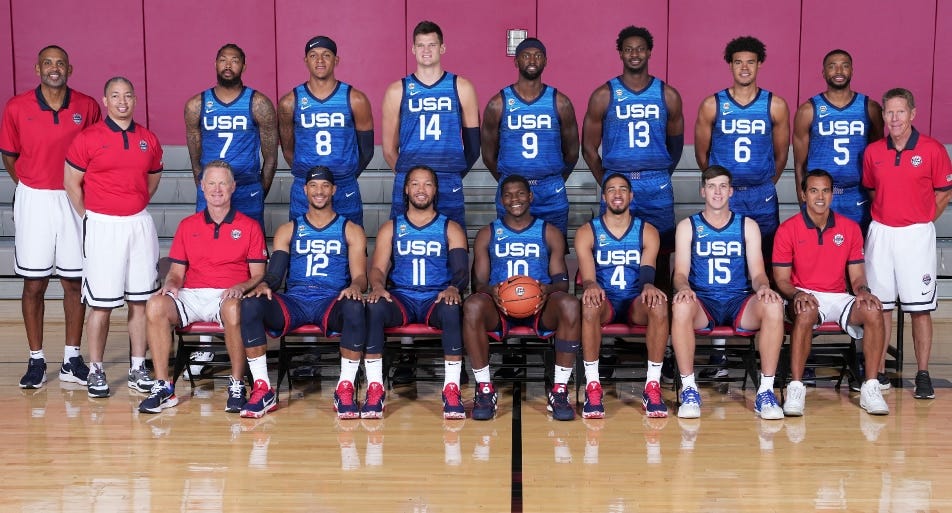
Team USA’s 12-man roster is constructed as follows:
Guards: Jalen Brunson (New York Knicks), Tyrese Haliburton (Indiana Pacers)
Wings: Josh Hart (New York Knicks), Austin Reaves (Los Angeles Lakers), Brandon Ingram (New Orleans Pelicans), Mikal Bridges (Brooklyn Nets), Cam Johnson (Brooklyn Nets), Anthony Edwards (Minnesota Timberwolves)
Bigs: Jaren Jackson Jr. (Memphis Grizzlies), Bobby Portis Jr. (Milwaukee Bucks), Paolo Banchero (Orlando Magic), Walker Kessler (Utah Jazz)
Who are the favorites?
While the United States is without any of the stars who helped carry them to Gold at the Tokyo Olympics, they will still be the favorites at the tournament.
Though the United States retains a significant talent advantage in terms of NBA experience, most other countries have far more regimented development programs. Their teams have been playing together since they were young, with chemistry going back as far as the U19 world cup.
The Americans will face strong competition including Tokyo runners-up France, the Canadians led by first-team all-NBA guard Shai Gilgeous-Alexander, Luka Dončić and Slovenia. Australia is loaded with NBA talent including SGA’s Thunder teammate Josh Giddey and veteran wing Joe Ingles. Spain head into the tournament ranked number one in the world but will be without star guard Ricky Rubio, who announced this week that he was taking time away from his career to focus on his mental health.
Reminder: Take care of yourself!
Why should you care?
These Americans are easy to root for
If their opening 117-74 victory in an exhibition against Puerto Rico is any indication, Team USA will play an aesthetically pleasing style of basketball. This team is stocked with athletes and versatile players, allowing Steve Kerr to implement a fast-paced system led by the team’s two point guards: Jalen Brunson and Tyrese Haliburton. Both of those guys were constantly pushing the pace off the dribble and throwing hit-ahead passes to the talented wing trio of Mikal Bridges, Anthony Edwards, and Brandon Ingram for them to attack 1 on 1 in space.
Steve Kerr emphasized tempo not only with his point guards but also with his frontcourt choices. Jaren Jackson Jr started in the middle for the Americans and was given license to pick the ball off the rim and push it off the dribble. When JJJ was off the floor, Kerr elected to put reigning rookie of the year Paolo Banchero in at the five, telling ESPN’s Tim Bontemps “One of the things we really found in [2021] in the Tokyo Olympics was having a 5 who can push the ball and transition and create plays is very difficult for FIBA teams to handle. So [Paolo Banchero] can play some 4, as he showed, but he’ll play plenty of 5, as well.”
Banchero is an interesting international story unto himself. Through his father, he holds an Italian passport and was all set to join the Italian side until this summer when Grant Hill, Team USA’s Managing Director, recruited him to join the Americans this summer and lock him into Team USA for the long term.
Whether they’re pushing the pace in transition or playing in the half-court, expect the ball to fly around the court, a refreshing break from the pick-and-roll, isolation-heavy NBA.
Off the court, Team USA is loaded with charming personalities for fans to root for. Josh Hart, Jalen Brunson, and Mikal Bridges were all teammates at Villanova and are now reunited with the national team. They’re always good for some comedy off the court as was seen when they celebrated together at Brunson’s wedding earlier in the summer. Timberwolves star Anthony Edwards has charisma in droves.
Austin Reaves’ story writes itself. Born in Arkansas, he started his college career at Wichita State before transferring to Oklahoma. He goes undrafted after starring for the Sooners and signs with the Lakers, where he’s gone from a meme to “keep this guy at all costs” in just two seasons for the purple and gold. His inclusion in Team USA is just another step in his remarkable rise, and as he showed against Puerto Rico, he can freaking play. He has an important role in this team too. He’ll be the team’s third ball handler behind Brunson and Haliburton.
Devoid of the big, accomplished stars that tend to headline American Basketball, this group is largely unproven. Both on and off the court, this World Cup will give fans a chance to see up-and-coming stars lead a team at the highest level.
FIBA rules are fun
FIBA games use slightly different rules than NBA fans will be used to. For one, if the ball is hanging on the rim or spinning around trying to decide whether it to go in or not, a defending center can smack the ball off without goaltending being called, as Draymond Green demonstrates here.
Four 10-minute quarters rather than twelve in the NBA make the game go faster, as does more lax officiating when it comes to ticky-tack fouls and a slightly smaller court. FIBA tends to be more physical overall, oftentimes to the befuddlement of NBA players who rely on getting to the line.
Single-elimination basketball
Single-elimination basketball strikes a stark contrast to the ho-hum of the average NBA game. Suddenly, professionals at the highest level face the same stakes one does at the neighborhood park: win or go home. It’s what drives the phenomena of March Madness. Teams can’t take a single game off.
One of the best parts about international basketball is getting to see top-level NBA talent lock in defensively from tip to the final whistle. Team USA will be anchored by reigning NBA Defensive Player of the Year Jaren Jackson Jr., whose shot-blocking chops were on display against Puerto Rico.
Jalen Brunson aside, Team USA’s roster is full of rangy wings who will pester opposition ball handlers and get into passing lanes with their length. Expect to see a lot of this from Mikal Bridges and Anthony Edwards. Brandon Ingram may be known for his smooth offensive game, but he has been open about his intention to impact the game defensively with Team USA. Ingram followed through on that promise with this swat in their opening exhibition game.
One eye on the Olympics
Ever since the Dream Team romped through Barcelona in 1992, Olympic Gold has been the expectation for American Basketball. A goal they have achieved all but once since then when in 2004 they had to settle for Bronze after being upset by the Greeks in the semifinals.
With that in mind, it’s likely that the roster Team USA sends to Paris will look different than this one, as several notable stars sat out.
There is an underlying question here that is just starting to be asked: who is the next apex superstar of American Basketball? Lebron led Team USA in 2008 and 2012, and Kevin Durant took over in 2016 and 2020. While Durant is the type of competitor who I could see suiting up again in Paris, he’s likely done his duty now at age 34.
Anthony Edwards has the potential to be that kind of guy, and this World Cup is being touted as a potential coming-out party for him, as the 2011 tournament was for Durant. In the final of that tournament, Durant dropped 28 points to lead the Americans past Turkey in Istanbul.
Jayson Tatum, Devin Booker, and Bam Adebayo were all contributors to Team USA’s victorious campaign in Tokyo and would likely walk into the starting lineup in 2024 with the potential of being game-changers. None of them have reached the NBA heights of James or Durant yet, with each of them losing in the NBA Finals, making the opportunity to lead Team USA to gold in Paris all the more alluring.
While these stars' possible inclusion next summer will likely keep some of the World Cup squad off the roster, this year’s competition in Southeast Asia provides a venue for these twelve guys to prove themselves as FIBA players and get on the American brass’ good side.
Next up for Team USA: back-to-back exhibition games this weekend against Slovenia (Saturday at 3:30 EST on FS1) and Spain (Sunday at 3:30 EST on FS1).